
Yes, chickens absolutely can get too much light, and this often occurs through incorrect intensity, inconsistent duration, or poor quality of illumination. For large farm operators and agricultural equipment dealers, managing light as a sensitive biological input is crucial for maintaining flock health and optimizing profitability. Using generic illumination instead of a specialized poultry farm lighting system can lead to stress, health issues, and reduced production yields. At szAMB, we believe light must be managed, not merely delivered, to ensure the success of our clients.
The Hazards of Excessive or Incorrect Illumination
When light is not precisely controlled, it transitions from a managerial tool to a stressor. Excessive light can manifest in several detrimental ways for chickens, creating costly biological and behavioral failures that directly impact the bottom line of our partners.
- Behavioral Stress and Aggression
High light intensity is a significant environmental stressor, particularly when compounded by the invisible flicker found in non-specialized commercial LED barn lights. Overly bright illumination can cause birds to become agitated, leading to serious behavioral problems that severely impact profitability. Stress is a direct inhibitor of growth.
- Increased Pecking and Cannibalism: Bright, uncontrolled light increases hyperactivity, making birds more prone to aggressive behaviors like feather pecking, which can easily escalate into cannibalism. This directly increases flock mortality and lowers the market value of the remaining birds due to injuries and feather damage. This is a risk we engineer our products to eliminate.
- Reduced Feed Intake and Poor FCR: In high-stress, overly bright environments, birds may become restless, leading to less time spent feeding and drinking. This directly compromises overall health and growth rates, resulting in a poor Feed Conversion Ratio (FCR). Our focus on creating calm environments is a focus on efficiency.
- Physiological Damage and Hormonal Disruption
Uncontrolled light, especially when delivered with intensity or lack of a dark cycle, can cause physical harm and disrupt the fundamental biological processes of the flock.
Eye Damage and Blindness: Prolonged exposure to very intense light can damage the retina, especially in young, developing birds, potentially leading to blindness and subsequent failure to find feed and water. This is an unnecessary loss of production that we help our clients avoid through precise lux control.
Hormonal Interference: Light regulates the vital endocrine system. Too much continuous light, or a lack of a proper dark cycle, severely interferes with the necessary production of melatonin, a hormone vital for rest, immune function, and stress response. We understand the essential need for a defined dark period and design our control systems to facilitate this critical cycle.
3. Economic Impact on Production and Operations
The failure to use a specialized system results in operational inefficiency and avoidable costs.
- Increased Energy Costs: Using unnecessarily bright or non-dimmable fixtures drives up electricity bills without providing any biological benefit to the flock. Our efficient LEDdesign minimizes energy consumption while maximizing biological efficacy.
- Poor Uniformity and Mortality: High-intensity light that is unevenly distributed creates hotspots and dark zones. Birds will naturally crowd into the dim or dark areas, leading to piling, crushing, and mortality, while feed and water are neglected in the bright zones. Our solutions ensure uniform illumination across the entire barn floor, maximizing available resources and minimizing clustering mortality.
Defining the “Optimal” Light Environment with szAMB Technology
An optimal environment is one where the intensity, duration (photoperiod), and quality (spectrum and flicker rate) are all precisely controlled and tailored to the bird’s life stage (broiler, layer, or breeder). This level of control is achieved only through a specialized poultry farm lighting system.
Precision Intensity Control
Light intensity must be managed via a specialized dimming system to allow the operator to transition the flock as needed. Generally, broilers often require low light intensity, typically around 5 to 10 lux or less, during the growth phase to promote calmness, increase consumption, and encourage rest, which maximizes the Feed Conversion Ratio (FCR). In contrast, layers require higher intensity, usually around 20 to 50 lux, during the laying period to stimulate peak egg production hormones, but this must be carefully managed to prevent aggression. Our technology provides smooth, flicker-free dimming from 100% down to 0.5% to meet these exact needs at every stage of the production cycle.
The Need for a Defined Dark Period and Smooth Transition
The concept of “too much light” also applies to duration. A consistent, daily dark period is biologically essential for the birds’ welfare and health, allowing for essential physiological processes, including bone calcification and immune system recovery, regulated by natural circadian rhythms. A proper poultry farm lighting system must simulate a gradual sunrise and sunset to ease the transition between light and dark, minimizing the sudden stress and panic that a harsh on/off switch causes. We ensure our Smart LED Dimmer Control provides these essential, programmatic soft start and soft shutdown cycles.
szAMB Solution: The Apex of Commercial LED Barn Lights
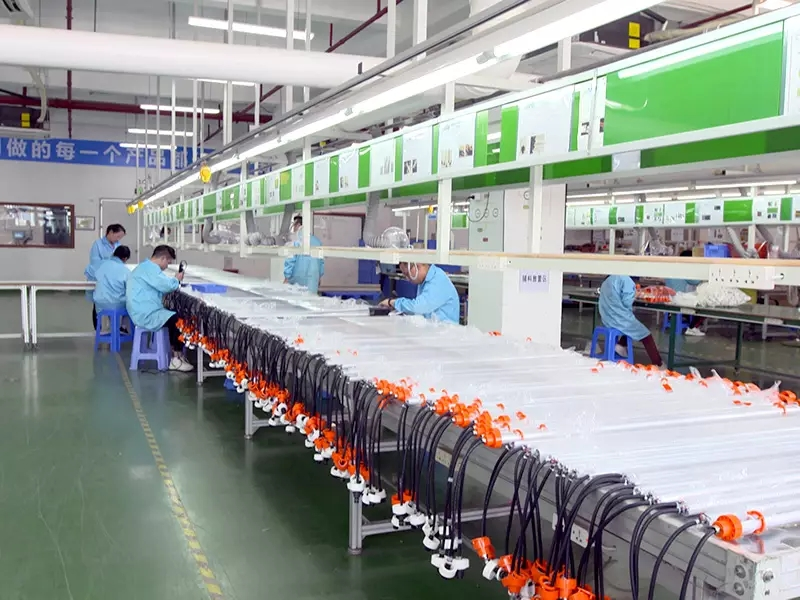
Managing light intensity and duration requires specialized equipment that goes far beyond standard general-purpose commercial LED barn lights. szAMB systems are engineered by us as biological management tools designed to eliminate the operational and biological problems associated with generic lighting.
Flicker-Free Assurance for Avian Welfare
Our primary technical feature that protects chickens from stress is 100% flicker-free dimming. As chickens are highly sensitive to flicker (with a Critical Flicker Fusion rate far higher than humans), the flicker inherent in poor-quality LEDs is perceived as a continuous strobe light, causing immense, undetectable stress. Our specialized drivers ensure that whether the light is at 100% intensity or dimmed down to 0.5%, it remains completely flicker-free, creating the calmest environment possible. This technical superiority directly translates to reduced feather pecking, improved feed uptake, and superior flock uniformity for our clients.
Ruggedness and Reliability for Long-Term ROI
For a poultry farm lighting system to be a profitable, long-term asset, it must be capable of precise control while simultaneously withstanding the harshest barn environment. Our commitment to quality means szAMB fixtures feature an IP67/IP69K rating and ammonia-resistant construction. These features ensure the lights resist rapid degradation from corrosive gases, common in barn air, and fully withstand the high-pressure, high-temperature washdowns essential for hygiene maintenance. We guarantee a long service life exceeding 80,000 hours, which secures the investment’s ROI and drastically reduces maintenance costs for large commercial operations.
By integrating a szAMB solution, our operators and partners gain access to the precise control over intensity, photoperiod, and light quality needed to transition from using light as simple illumination to using it as a sophisticated management tool that directly enhances animal welfare and production efficiency. We don’t just sell lights; we sell proven environmental control systems designed for profit and durability.