
At szAMB, we have specialized in poultry lighting systems since 2006, operating as a national high-tech enterprise in China under ISO9001 and ISO14001 standards. One question we hear constantly from commercial egg producers is: How many hours of light do laying hens need? Based on decades of field research and thousands of poultry barn installations worldwide, the answer is not a single number—it depends on the hens’ age, breed, and production stage. However, the universally accepted guideline for peak laying performance is 14 to 16 hours of consistent light per day, followed by 8 to 10 hours of uninterrupted darkness. Getting this balance right requires more than just a timer; it demands high-quality LED lights for laying hens that deliver flicker-free, dimmable illumination tailored to avian biology.
Why Photoperiod Length Directly Impacts Ovulation
Hens are photosensitive creatures. Light stimulates the pituitary gland to release follicle-stimulating hormone (FSH) and luteinizing hormone (LH), which trigger ovulation. Too few light hours—say, under 12 hours—can reduce egg production by 30% or more. Too many light hours—over 17 hours—can cause exhaustion, prolapse, or aggressive pecking. The sweet spot is 14–16 hours. However, abrupt changes in day length stress hens. That is why our LED lights for laying hens feature worldwide top dimming technology (0.2%–100% flicker-free) and instant “ON” to 100% brightness, allowing gradual photoperiod increases of 15–30 minutes per week. This mimics natural spring day lengthening and encourages steady laying without shock.
Technical Features That Make Our Laying Hen Lighting Superior
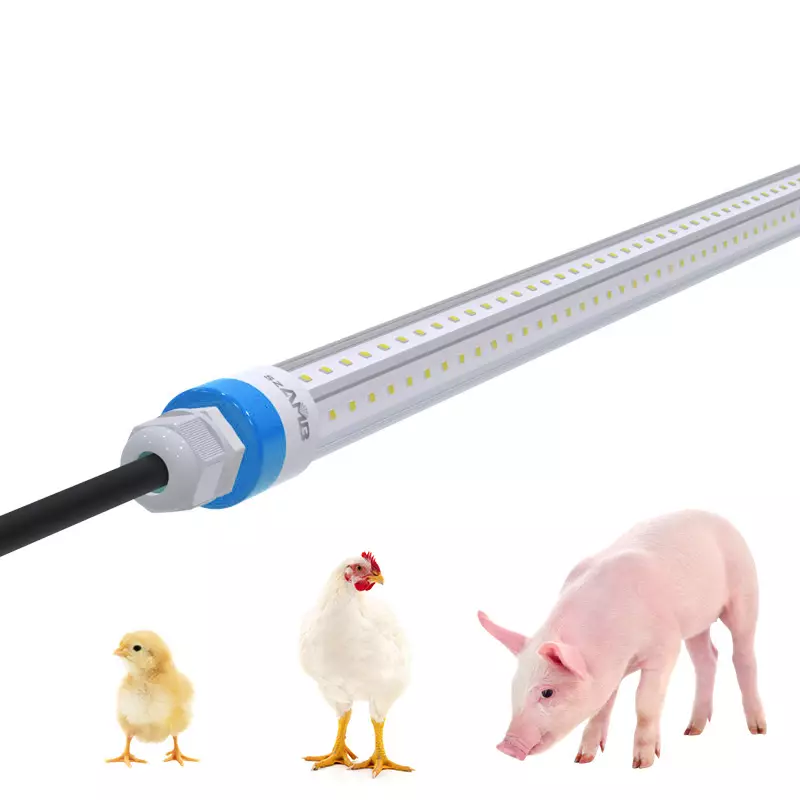
Not all fixtures perform equally in poultry barns. Ammonia, humidity, dust, and power washing destroy standard tubes quickly. Our T8 LED lighting solution is specifically engineered for these harsh conditions. The V-shape patent design with a 270° aluminum radiator structure ensures excellent thermal efficiency, keeping operating temperatures below 50°C. This low-heat profile matters because hens perch close to light sources. Additionally, our laying hen lighting system is IP67 rated—humidity proof, dust proof, shatter proof, and waterproof. It also features optimal anti-ammonia and acid resistance for poultry industrial environments. The human-centric design includes a 360° rotating end cap with scale, allowing you to adjust angle and position without tools. No UV, no IR, no mercury—just clean, safe illumination that works with worldwide electrical systems.
Practical Scheduling Strategies for Different Production Stages
For pullets (18–22 weeks), begin with 12–13 hours of LED lights for laying hens and increase by 15 minutes weekly until reaching 15–16 hours at peak lay (25–35 weeks). During late lay (after 60 weeks), reduce to 14 hours to prevent metabolic stress. Always maintain at least 8 hours of total darkness for rest, as hens require melatonin cycles for immune function. Using our 0.2%–100% dimming capability, you can simulate sunrise and sunset, eliminating the panic that sudden “ON/OFF” switching causes. This approach, combined with our shatter-proof and anti-ammonia design, has helped farms worldwide achieve 90–95% peak production rates with lower mortality.
Maximizing Flock Performance Through Precision Lighting
Determining how many hours of light laying hens need is not guesswork—it is science. With 14–16 hours of properly managed photoperiod using szAMB’s certified LED lights for laying hens, you can expect consistent egg size, shell quality, and lay rates. Our T8 fixtures, with V-shape cooling, IP67 protection, and flicker-free dimming from 0.2% to 100%, deliver the reliability that modern poultry operations demand. From pullet rearing to peak lay and late production, our laying hen lighting solutions are designed to enhance welfare, reduce energy costs, and maximize ROI. Contact szAMB today to retrofit your barn with lighting that works as hard as your hens do.