
For decades, poultry producers relied on incandescent and fluorescent technologies, which, while inefficient, offered predictable light quality. Today, the shift toward LED lighting is undeniable, driven by massive energy savings and longevity. However, for a sector as biologically sensitive as poultry farming, this transition raises a critical question: Is LED light ok for chickens?
The simple answer is a resounding “Yes,” but with a vital caveat: only specialized LED solutions are acceptable. Generic commercial or residential LED fixtures are not just suboptimal—they can be detrimental to bird welfare, health, and production efficiency. For major farm operators, equipment manufacturers, and agricultural dealers looking to ensure high yields and low operating costs, understanding the biological and technical differences that define high-quality poultry lighting is paramount. The lighting system you choose is not a cost center; it is a critical biological input, and choosing wisely is the first step toward maximizing your flock’s potential.
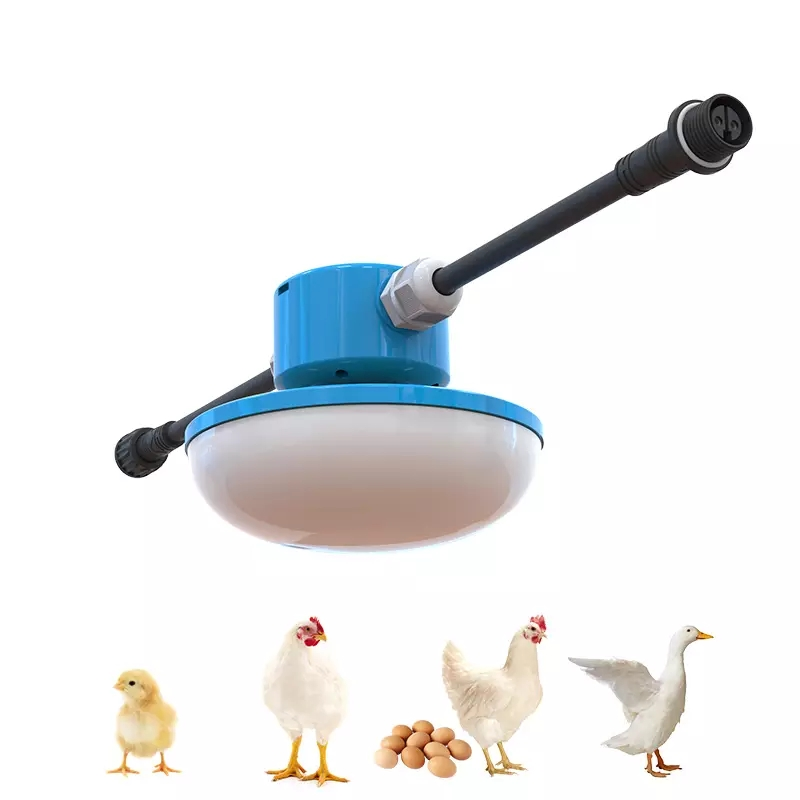
The Avian Visual System: Why Chickens See the World Differently
To appreciate the necessity of specialized LED technology, one must first recognize that the visual world of a chicken is fundamentally different from that of a human. Humans are trichromatic, relying on three primary color receptors. Chickens, however, are tetrachromatic, possessing a fourth cone receptor that extends their vision into the ultraviolet (UV-A) spectrum, which is entirely invisible to humans.
This enhanced vision means that chickens perceive light more intensely and are sensitive to light properties we cannot detect. Furthermore, light does not just affect their sight; it influences their entire endocrine system. Light penetrates the thin skull of the bird and stimulates deep-brain photoreceptors, regulating the release of crucial hormones like melatonin and reproductive hormones. A lighting system that looks “fine” to a human operator may be biologically disruptive, confusing, or stressful to the flock. High-quality poultry lighting must be engineered to align with this complex avian physiology, not merely the requirements of the human work environment.
The Invisible Strobe: The Technical Failure of Standard LEDs
The single most destructive feature of non-specialized LED lighting is its propensity to flicker. This technical issue is the key reason why the answer to the topic question is so nuanced. The human eye has a Critical Flicker Fusion (CFF) rate—the speed at which light appears continuous—of around 50 to 60 Hertz (Hz). Most standard commercial and residential LED drivers operate at this frequency. Chickens, due to their faster vision, have a CFF that can exceed 120 Hz and sometimes up to 200 Hz.
What appears to a human operator as smooth, stable light is perceived by the chicken as a ceaseless, rapid, high-intensity strobe light. This chronic visual bombardment acts as a massive environmental stressor. The physiological consequences are substantial and costly: elevated stress hormones, increased anxiety, hyperactivity, and aggressive behaviors such as feather pecking and cannibalism. These issues directly translate into reduced feed intake, poor feed conversion ratios, compromised immune systems, and higher mortality rates. To deliver genuine animal welfare and production benefits, LED barn lights must feature 100% flicker-free dimming across their entire operational range. This technical capability eliminates the invisible stressor, leading to calmer birds, better weight gain, and fewer behavioral issues.
Spectrum Control: Wavelength as a Management Tool
Beyond simply eliminating flicker, specialized LED technology allows for the controlled deployment of specific light wavelengths to drive targeted biological responses. This capability is impossible with old fluorescent or incandescent bulbs and is the core of modern poultry lighting science.
The light spectrum is strategically used to manage both growth and reproduction. For laying hens and breeders, the red spectrum (around 630-650 nm) is vital. Because red light penetrates the skull more effectively than blue or green light, it efficiently stimulates the photoreceptors that control reproductive hormones, directly promoting sexual maturity and maximizing long-term egg production yield. Conversely, for broilers, the blue and green spectra are prioritized during the initial and mid-growth phases. Blue light has a natural sedative effect, reducing bird mobility and stress, which channels metabolic energy primarily toward muscle and lean tissue development, leading to better feed efficiency and uniformity. Strategic spectrum control allows operators to essentially “program” the physiological and behavioral state of their flock at every life stage.
szAMB: Engineered for Agricultural Excellence and Verified ROI
For large farm operations, the return on investment for lighting is realized only through uncompromised durability and precision control. This is where the engineering expertise of szAMB, a specialized ODM and OEM company, becomes invaluable. Generic lights are simply not built to survive the aggressive operating conditions of a poultry house, leading to constant maintenance and rapid replacement costs.
szAMB LED barn lights are engineered to be a reliable, long-term asset. Their fixtures boast an IP67/IP69K rating, which guarantees total protection against dust ingress and the capacity to withstand the high-pressure, high-temperature washdowns essential for hygiene maintenance between flocks. Crucially, the fixtures are constructed with ammonia-resistant materials. This feature is non-negotiable in facilities where corrosive ammonia gas, a natural byproduct of bird waste, rapidly degrades standard electrical components. This robust, specialized design ensures that the szAMB lighting system achieves a service life exceeding 80,000 hours, drastically reducing the lifetime ownership cost and maintenance burden.
Furthermore, the integration of Smart LED Dimmer Control allows operators to fully capitalize on the biological potential of the lighting system. This system provides the programmatic control necessary for managing complex photoperiods and simulating a gradual sunrise and sunset. This soft transition is essential for preventing the panic and stress that a sudden light change can induce, promoting calm and stability in the flock.
The Path to Optimal Production
By moving away from generalized lighting and adopting specialized, science-backed poultry lighting from experts like szAMB, farm operators can immediately translate advanced technology into tangible production gains. Verified results from field implementations consistently show the positive impact of this precise environmental control, including significant reductions in floor egg incidents, measurable increases in bird body weight, and dramatic decreases in mortality rates—all attributable to a stress-free, biologically optimized light environment.
Ultimately, the question of whether LED light is okay for chickens depends entirely on the sophistication of the technology. The transition requires professional-grade equipment that aligns technical specifications with avian biology. For those focused on operational excellence, longevity, and maximizing the genetic potential of their flocks, specialized szAMB LED barn lights are the definitive, profitable choice.