
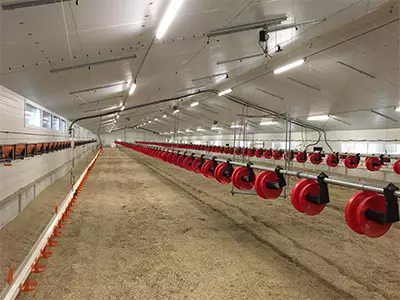
In poultry farming, lighting plays a direct role in how birds grow, behave, and produce. It is not only about visibility inside a barn but also about creating a controlled environment that supports stable biological rhythms. Farmers carefully manage light intensity, duration, and color to match different production stages. For example, broiler chickens are typically raised under controlled low to moderate light levels, while laying hens require structured lighting schedules that help regulate egg production cycles. The goal is to mimic natural daylight patterns while maintaining consistency in indoor conditions.
Why LED Lighting Is Widely Used in Poultry Farms
Modern poultry operations have largely shifted to LED systems because they offer practical advantages over traditional lighting technologies such as fluorescent or incandescent bulbs. LED systems provide more stable illumination, lower energy consumption, and significantly reduced heat output. This is especially important in enclosed barn environments where temperature control is critical for animal health. Another advantage is durability, as LED fixtures require less frequent replacement, which reduces maintenance interruptions in large-scale operations. These factors make LED lighting a preferred choice for farms that prioritize efficiency and long-term operational stability.
The Role of Lighting Design in LED Livestock Systems
In livestock environments, lighting is more than a background utility. It is part of the overall management system that affects visibility, animal comfort, and worker efficiency. Properly distributed lighting helps farmers observe animal conditions more clearly and respond quickly when needed. This is where commercial LED barn lights become especially relevant. These lighting systems are designed to cover large indoor spaces evenly, ensuring that no area is too dim or overly bright. Consistent illumination helps reduce stress in animals and supports more predictable behavior patterns across the herd or flock.
Lighting Strategy and Animal Behavior
Different lighting conditions can influence how poultry behaves throughout the day. Warm light is often used during resting periods, while more neutral lighting may support feeding activity. Adjusting these conditions carefully helps maintain a balanced environment that supports both productivity and animal welfare. In addition, gradual changes in lighting are preferred over sudden shifts, as abrupt changes can cause unnecessary stress. This is why modern barn lighting systems often include dimming capabilities and programmable settings.
How We at szAMB Approach Poultry and Livestock Lighting
At szAMB, we focus on designing lighting systems that meet the real operational needs of poultry and livestock environments. Our approach to LED livestock lighting considers durability, energy efficiency, and consistent performance in demanding barn conditions.
We also develop commercial LED barn lights that are built for large-scale agricultural spaces, where stable illumination is necessary for both animal management and daily farm operations. Our goal is to provide lighting solutions that help create more controlled and manageable environments without adding complexity to farm workflows.
Conclusion
Poultry farming relies heavily on carefully controlled lighting systems, and LED technology has become the standard choice due to its efficiency and adaptability. From regulating animal behavior to supporting farm operations, lighting plays a central role in livestock management. With advancements in commercial LED barn lights and LED livestock systems, farms can achieve more consistent environments that support both productivity and animal welfare. At szAMB, we continue to focus on practical lighting solutions that align with the evolving needs of modern poultry production.