
As poultry farms continue seeking practical ways to stabilize and improve laying performance, lighting has become one of the most influential environmental factors. In our daily work at szAMB, we focus on understanding how light intensity, wavelength, and distribution directly shape hen behavior and their biological rhythms. With the increasing use of LED lights for laying hens, more farms are exploring whether refined lighting strategies can truly support higher and more stable egg output. Based on our long-term research, we recognize that a well-designed lighting environment contributes to a more consistent laying cycle, especially when paired with a system built for precision and animal comfort.
Light Quality and Its Influence on Egg Production
The process of egg formation is closely linked to a hen’s hormonal rhythm, which is stimulated by light signals. When we apply poultry lighting for egg production with controlled wavelengths, hens receive clearer cues that regulate feeding, resting, and laying times. This steady rhythm supports predictable behavior, allowing farms to create a calmer and more productive environment. At szAMB, we design our solutions around these biological needs rather than relying on assumptions, ensuring that each light source contributes meaningfully to flock performance. By providing consistent brightness and reducing unnecessary stress, LED lights for laying hens help maintain stability during peak laying periods and support long-term productivity.
Practical Advantages of LED Lighting Solutions
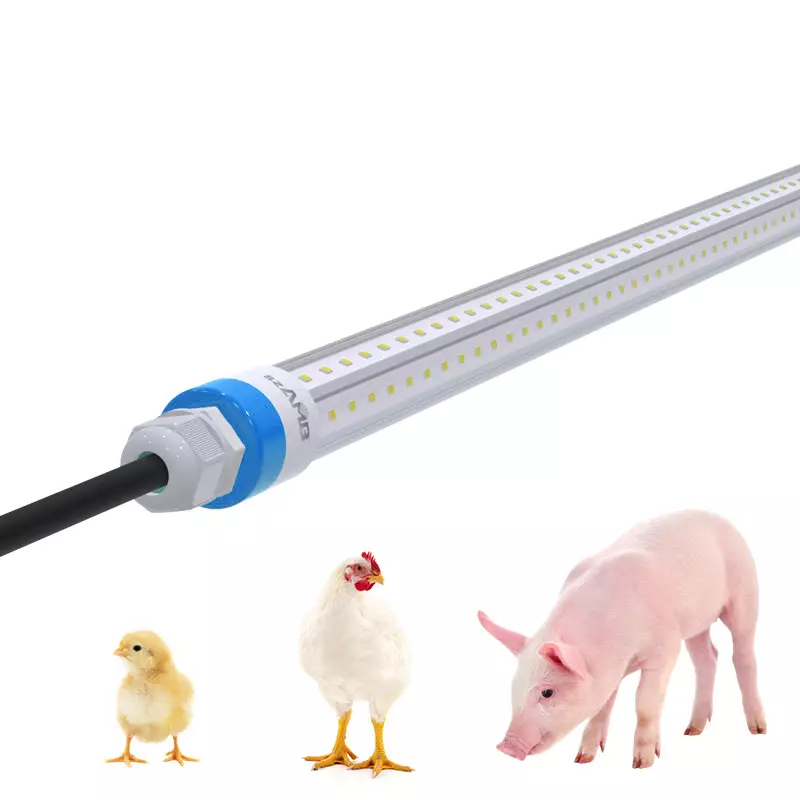
Many farms choose LEDs not just for efficiency but for their functional benefits within poultry houses. Our use of poultry lighting for egg production focuses heavily on minimizing flicker, controlling heat, and maintaining durability in challenging environments. This approach ensures that lights remain uniform and reliable throughout daily operations. To support these goals, we developed our T8 LED Lighting with several practical features: a V-shape 270° aluminum radiator for improved cooling, a 360° rotating end cap for flexible adjustments, and instant full-brightness performance without UV or IR radiation. The system also offers dimming ranges from 0.2% to 100% without flicker, enabling farms to create gradual sunrise and sunset effects that hens respond to naturally. With IP67 protection and strong resistance to ammonia and humidity, it is built to match the harsh conditions common in poultry spaces.
Conclusion: How Adjusted Lighting Supports Higher Output
When considering how LED illumination influences production, the answer lies in biological alignment and environmental consistency. By applying LED lights for laying hens that match the natural responses of hens, farms can maintain a stable laying rhythm and reduce avoidable stress. Our experience at szAMB shows that precise systems such as our T8 LED Lighting support this goal by offering reliable performance, adaptive brightness, and durability in demanding environments. As farms look for dependable methods to enhance results, well-planned poultry lighting for egg production remains a practical tool that aligns animal behavior with the operational needs of modern egg production.