
Effective lighting management in poultry operations plays a key role in bird behavior, growth patterns, and productivity. Farmers are increasingly focusing on how light duration, intensity, and uniformity influence feeding cycles and laying performance. Within this context, modern poultry facilities are moving away from traditional lighting systems toward LED-based solutions designed for controlled environments.
Research and field practice show that poultry lighting is not just about brightness. It involves structured management of photoperiods, gradual transitions, and consistent distribution across housing areas to avoid stress and uneven behavior among flocks.
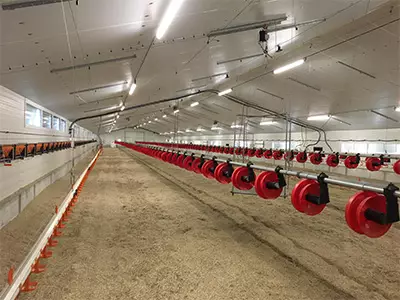
The Role of Commercial LED Barn Lights in Farm Environments
Commercial LED barn lights are now widely used in agricultural facilities because they offer stable illumination, low heat output, and improved energy efficiency compared with older lighting technologies. In poultry houses, these lights help maintain consistent visibility across feeding, resting, and nesting areas.
The design of barn lighting also matters. Wide beam angles and uniform coverage help reduce shadows, which can influence movement patterns and reduce unnecessary agitation in birds. According to barn lighting design practices, proper placement and output balance are essential for ensuring even illumination across large indoor agricultural spaces.
Lighting Management in Poultry with szAMB Systems
In poultry farming, lighting schedules are often adjusted based on growth stages. Chicks, growers, and laying hens each require different light durations to support natural biological rhythms. With proper lighting management in poultry environments, farmers can guide feeding behavior, support resting cycles, and maintain stable production conditions.
szAMB integrates this principle into its agricultural lighting solutions by combining commercial LED barn lights with structured control systems. These systems allow farmers to manage brightness levels and timing across different sections of a poultry house. As noted in agricultural lighting applications, LED systems can also support dimming and programmable control, making them suitable for precision farming environments.
szAMB focuses on creating lighting environments that support consistency rather than abrupt changes. This is particularly important in poultry houses where sudden shifts in brightness may disrupt flock behavior. Controlled transitions simulate natural daylight patterns, which helps reduce stress and maintain stable production cycles.
Practical Benefits for Poultry Operations
When lighting is properly managed, poultry farms can achieve more stable flock performance. Commercial LED barn lights contribute to this by offering long service life and reduced maintenance needs, making them suitable for continuous operation environments.
With szAMB lighting systems, farmers can adjust light intensity based on flock age and barn layout. This flexibility supports different poultry stages, from brooding to laying periods. In addition, LED systems help maintain uniform visibility across large barns, improving monitoring and general farm operations.
Energy efficiency is another important factor. LED-based barn lighting reduces unnecessary energy consumption while maintaining required illumination levels. This supports both operational cost control and environmental efficiency goals commonly considered in modern farming systems.
Conclusion
Lighting management in poultry farming is a structured process that directly influences flock behavior and productivity. By integrating commercial LED barn lights with controlled systems, farms can achieve more stable and predictable lighting environments.
szAMB provides lighting solutions designed for agricultural settings where consistency, durability, and control are essential. Through balanced illumination and adaptable management systems, poultry operations can better align lighting conditions with the natural needs of their flocks, supporting smoother daily cycles and more efficient farm management.