
In the highly specialized world of poultry production, light is far more than just illumination—it is a critical non-nutritional feed resource and a powerful physiological tool. For commercial operations, equipment manufacturers, and dealers focused on maximizing output, understanding the precise impact of light on reproductive physiology is essential. Proper management of the light environment directly influences the health, welfare, and, most importantly, the productive lifespan of laying hens.
As an ODM and OEM partner, szAMB engineers advanced LED solutions to leverage this photobiological imperative. By precisely controlling the light spectrum, duration, and intensity, producers can optimize the environment for peak egg production and quality.
The Mechanism: Why Light Governs Egg Production
The reproductive cycle of a hen is fundamentally controlled by light through both the eyes and, critically, through extra-retinal photoreceptors located in the brain, particularly the hypothalamus. Light, especially the long wavelengths found in the red light spectrum, can penetrate the hen’s skull to reach these deep brain receptors. This stimulation triggers a powerful neural-hormonal cascade: the hypothalamus releases Gonadotropin-Releasing Hormone (GnRH), which then stimulates the pituitary gland to release Follicle-Stimulating Hormone (FSH) and Luteinizing Hormone (LH). These hormones ultimately drive follicular development and maturation in the ovary, initiating the reproductive cycle and the onset of lay. Since birds are seasonal breeders, they perceive the duration of the day to be long (photostimulatory) when light is present during a specific photosensitive phase. Providing fewer than 12 hours of light can delay the onset of lay or cause production to cease entirely. Furthermore, beyond reproduction, light profoundly influences behavior. Hens are highly sensitive to rapid fluctuations and color changes. High light intensity, generally above 30 lux, can increase nervousness and aggression, while a consistently stable light environment promotes calmness, reduces stress, and ensures uniform feed and water intake, which is essential for consistent egg quality and shell strength.
The Laying Hen Lighting Blueprint: Intensity, Duration, and Spectrum
To maximize egg production and persistence of lay, lighting must be managed across the rearing (pullet) and laying (production) phases. Manipulating the photoperiod and intensity at the right time is the single most important management tool for laying hen lighting. The following table summarizes the key targets for intensity and photoperiod across these two crucial phases of production:
Phase | Duration (Age) | Photoperiod (Hours of Light) | Target Intensity (Lux) | Key Spectral Requirement |
Rearing (Pullet) | 0 to 18 Weeks | Gradually decreased to 8 hours | Starts at 20-30 lx; Dims to 5–10 lux | Often cool/neutral white; blue/green bias for growth/uniformity. |
Production (Layer) | 18 Weeks + | Gradually increased to 14–16 hours | Stable 10–30 lux (at trough level) | Red Spectrum (long wavelength) for reproductive stimulation. |
Photoperiod Management (Duration)
The core rule for laying hen lighting is simple: never decrease the hours of light once production has been stimulated. During the rearing phase (0–18 Weeks), pullets are intentionally kept on a short day (typically 8 hours of light) to delay sexual maturity. This strategy allows the birds to reach a proper body weight and frame size, ensuring the reproductive system is mature enough to sustain a long, high-production cycle. At the target age for the Production Phase (around 18–20 weeks), the light duration is increased gradually (e.g., 30 minutes to 1 hour per week) until a maximum of 14–16 hours of light is reached. This increase is the specific trigger that initiates the hormonal cascade for egg production, and this duration must then be maintained or slowly increased throughout the life of the flock to ensure persistency of lay.
Spectral and Intensity Management
Intensity management during the production phase is equally critical; it should be kept stable and low to prevent nervousness, typically maintaining 10 to 30 lux at the bird or feed trough level. The choice of light spectrum is particularly crucial for layers because red light (around 630–660 nm) is the most essential spectrum for production. It penetrates the hen’s skull most efficiently, providing maximum stimulation to the hypothalamic photoreceptors. Research consistently shows that red-enriched light enhances egg production rates and improves egg mass compared to other colors. Finally, uniformity is key, as uneven lighting creates dark spots where hens may congregate or lay eggs outside of designated nest boxes; specialized LED lights for laying hens must provide a wide, uniform distribution across the entire house.
The szAMB Technical Advantage: Precision LED Lights for Laying Hens
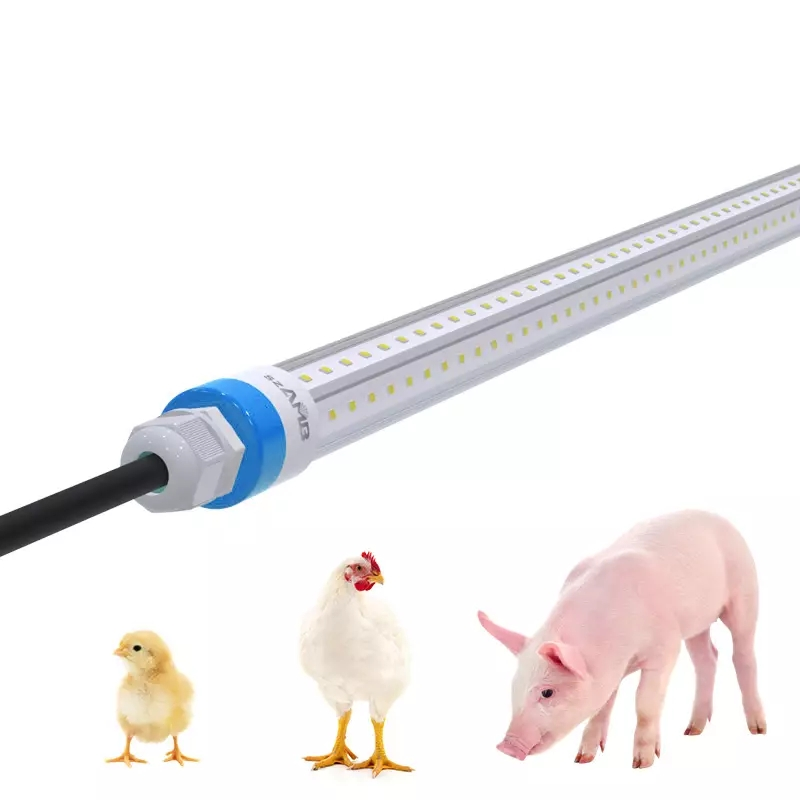
Achieving the scientific precision required for optimal layer production demands advanced lighting technology that can endure harsh farming environments. szAMB develops highly durable, energy-efficient LED lights for laying hens that solve the major challenges of commercial farming environments. Our T8 LED lighting solution, specifically designed for poultry, delivers on critical technical specifications.
First, we utilize advanced Flicker-Free technology. Chickens have a much higher flicker fusion rate (FFR, up to 120 Hz) than humans, meaning standard fluorescent or poor-quality LED lighting appears to them as a distracting, stressful strobe. Our systems are engineered to be completely flicker-free, ensuring a stable visual environment that minimizes stress, nervousness, and aggressive behaviors, thereby supporting better feed intake and lay performance.
Second, our systems offer full spectrum and dimmability, which is paramount for photostimulation. szAMB’s systems provide full-spectrum output that can be optimized for the critical red wavelengths required for reproduction. Furthermore, the 100-0% smooth dimming capability allows for the precise simulation of gradual sunrise and sunset. This natural transition reduces stress, helps hens find their perches before total darkness, and prevents the abrupt shifts that can induce panic and disrupt the laying cycle.
Finally, we guarantee superior durability and ROI. Laying hen environments are corrosive due to ammonia, dust, and frequent high-pressure washdowns. Our fixtures boast an IP67/IP69K rating, certifying complete protection against dust, moisture, and high-pressure water jets used during sanitation. This robust construction ensures long-term operational stability and guarantees a lifespan of over 80,000 hours, offering a critical return on investment for large-scale operations and equipment suppliers.
Conclusion
The strategic application of light in poultry farming is not optional; it is a fundamental driver of reproductive success. By precisely managing the photoperiod, intensity, and spectrum—and crucially, by utilizing reliable, flicker-free, and spectrum-optimized LED lights for laying hens—producers can scientifically manipulate the environment to maintain high yields and excellent welfare. szAMB provides the precision-engineered lighting systems required by modern poultry professionals. We partner with equipment manufacturers and farm operators to deliver custom laying hen lighting solutions that turn lighting management into a measurable commercial advantage.
Contact szAMB today to discuss how our T8 LED solutions can optimize your flock’s productivity and longevity.