
In poultry farming, lighting is part of the production environment rather than a simple source of visibility. The timing, intensity, distribution, and controllability of light can influence how birds move, feed, rest, and respond to daily routines.
For broiler houses, layer houses, and other poultry facilities, a suitable poultry lighting system should provide stable illumination, smooth control, and reliable performance under dusty and humid conditions. The goal is to create a more manageable environment for the flock while helping farm operators control energy use and daily work.
This guide explains how light affects flock behavior and energy use, and what to compare when selecting LED poultry lights.
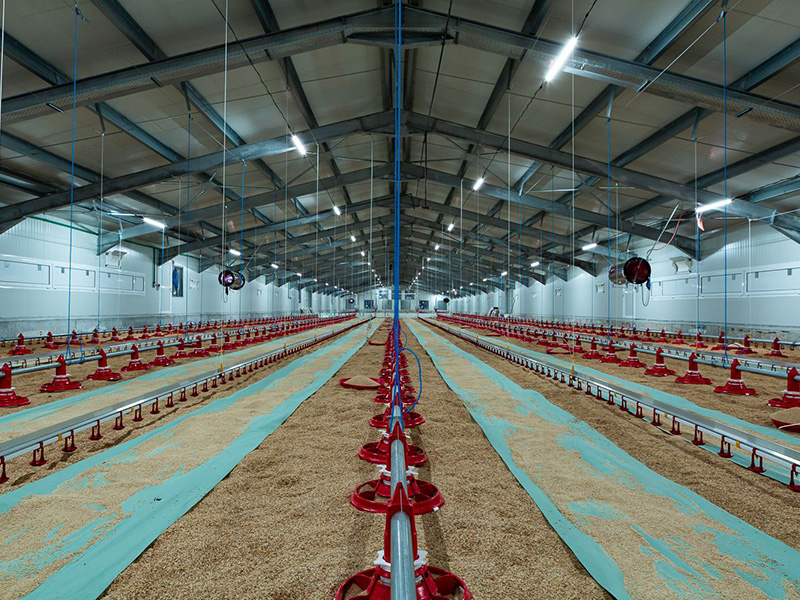
A szAMB LED poultry lighting system installed in a broiler farm to provide stable and uniform illumination.
How Lighting Supports Poultry Welfare and Daily Behavior
Poultry respond to changes in their visual environment. Sudden changes in brightness, uneven illumination, or visible flicker can make the barn environment less comfortable and more difficult to manage. A well-planned lighting program helps create a predictable routine for feeding, resting, inspection, and movement.
Smooth dimming is especially useful when the lighting level needs to change gradually. Instead of switching abruptly between bright and dark conditions, operators can use controlled transitions that better match the daily rhythm of the flock. Flicker-free operation also helps maintain a more stable visual environment inside the poultry house.
Lighting Programs Should Match the Production Stage
The lighting requirements of a poultry house can change as the flock develops. Broilers, layers, and breeding birds may follow different management programs, so a lighting system should be flexible enough to support the selected schedule.
Operators may need to adjust lighting duration, brightness, and transition speed according to bird age, production objectives, and house activities. Dimmable LED poultry lights make these adjustments easier to manage and can help maintain a consistent routine across the flock.
Lighting should therefore be planned together with ventilation, feeding, stocking density, and other operating conditions rather than treated as an isolated equipment decision.
How Poultry House Lighting Supports Flock Performance
Consistent poultry house lighting helps operators maintain a clearer and more predictable working environment. Uniform distribution reduces heavily shaded areas, making it easier to inspect birds, observe equipment, and carry out routine tasks throughout the house.
A controllable lighting system also gives farms more flexibility when coordinating light schedules with feeding, cleaning, and flock management. These operational improvements do not replace good nutrition or ventilation, but they can support a more stable production environment when used as part of a complete farm management program.
What to Consider When Choosing LED Poultry Lights
When evaluating LED poultry lights, farm operators should consider the complete operating environment rather than wattage alone. Important factors include:
- Light distribution: Illumination should reach the working and animal areas with minimal dark zones.
- Dimming control: The system should support gradual changes when the lighting program requires them.
- Flicker performance: Stable output helps provide a more consistent visual environment.
- Environmental protection: Dust and moisture resistance are important in poultry houses.
- Service life and maintenance: Long-lasting components can reduce replacement work and interruptions.
- Installation requirements: A practical system should be compatible with the existing house layout and control equipment.
Efficient LED poultry lighting can reduce electricity demand, but the final result also depends on mounting height, spacing, operating hours, and the lighting schedule selected for the flock. See the full poultry lighting fixture range with IP ratings, beam angles and dimming options.
Plan a Poultry Lighting System for Your Farm
A poultry lighting system should be selected according to the type of house, flock, lighting schedule, mounting conditions, and control requirements. The right solution can make daily management more predictable while supporting a comfortable and energy-conscious production environment.
szAMB develops commercial LED barn lights and poultry lighting systems for broiler farms, layer houses, and other livestock applications. Our solutions can be configured for requirements such as uniform illumination, dimming control, long operating hours, and demanding barn conditions.
If you are upgrading an existing poultry house or planning a new lighting installation, contact szAMB to discuss the house layout, flock type, operating schedule, and lighting control requirements. Or browse poultry lighting products to compare models before requesting a quote.