
In livestock production, lighting is used to support visibility, animal management, and behavioral stability. We focus on how pigs respond to brightness levels, daily exposure time, and indoor visual comfort when designing systems for barn environments. In most cases, pigs react more strongly to changes in light intensity and timing than to specific color variations, although spectrum still plays a supporting role in overall conditions.
At szAMB, we build pig lighting solutions aimed at creating stable and practical environments that support daily farm operations and animal wellbeing.
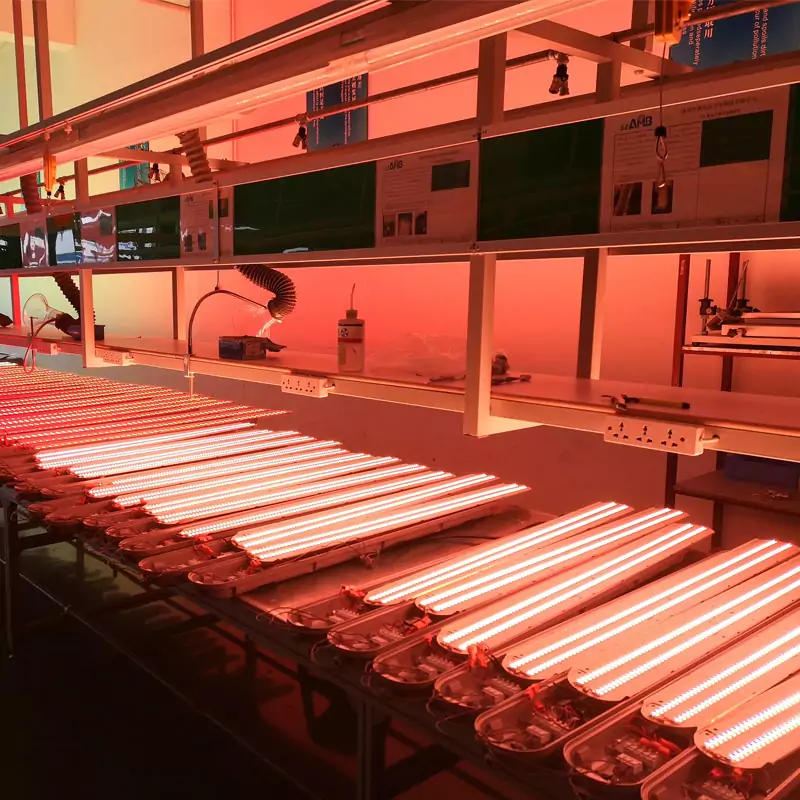
Color Response in Barn Lighting Conditions
Pigs do not perceive color in the same way humans do, and their response to different wavelengths is limited. Under typical farming conditions, light that resembles natural daylight tends to work most effectively because it aligns with their natural activity rhythm. In contrast, certain long-wavelength lighting may be perceived as less stimulating and is sometimes used in controlled situations where reduced disturbance is desired.
For continuous barn use, lighting that closely matches daylight conditions is generally preferred because it provides a balanced visual environment.
Design Factors in Livestock Lighting Systems
When planning illumination for livestock housing, color alone is not the main consideration. We prioritize overall brightness, distribution, and consistency across the barn space. Uniform lighting helps animals move freely and reduces areas of uneven visibility that may affect behavior or comfort.
Stable lighting schedules are also important, as they help regulate daily activity cycles such as feeding and resting. LED systems allow more precise control over these elements compared to traditional lighting options.
Behavioral Patterns Under Controlled Illumination
Animal behavior in barns is closely linked to lighting management. With consistent and evenly distributed illumination, pigs tend to show more predictable movement and resting patterns. This helps create a more organized environment for farm operations.
In darker or uneven lighting conditions, animals may change their activity levels or avoid certain areas, which can affect overall barn efficiency. Proper lighting design helps reduce these inconsistencies and supports smoother daily routines.
Our Approach at szAMB
At szAMB, we focus on developing barn lighting solutions that prioritize practicality and environmental stability. We consider how illumination supports visibility for workers while also maintaining a comfortable setting for animals.
Our systems are designed to deliver consistent brightness, balanced distribution, and reliable daily cycles that align with farm management needs. Instead of focusing on decorative lighting effects, we emphasize functional performance suited for livestock environments.
Conclusion
Effective barn illumination depends on more than visual appearance. It requires careful attention to brightness, consistency, and animal response within the space. When these elements are balanced, farm operations become more efficient and environments remain more stable.
With szAMB swine light solutions, we aim to support practical and well-structured environments that meet the needs of both livestock and farm management.